4191057

🚀 The Future of Aging: Can We Reverse Time? A Deep Dive with Marco Quarta

😂 My Scale Thinks I’m 12—The Science of Aging Says Otherwise

So, here’s a fun one—my scale at home has been giving me a biological age of 12. Yes, 12 years old! I’m 47, so while I love the compliment, I’m not entirely convinced my metabolism got the memo! But what if there were more scientific ways to assess and influence aging?

That’s exactly what we explored in my latest conversation on my podcast with Marco Quarta, co-founder and Chief Scientific Officer of Rubedo Life Science. We’re talking about regenerative medicine, reversing cellular decline, and the future of longevity therapeutics. What if aging wasn’t a one-way street? What if we could slow it down—or even reverse its effects? Marco and his team are working on exactly that.

🧪 The Science of Aging: What’s Really Happening?

Aging isn’t just about getting older; it’s about cellular decline. One of the biggest culprits? Senescent cells—often called zombie cells—which refuse to die and wreak havoc on our bodies, causing inflammation and age-related diseases.

Rubedo Life Science has developed a new approach to selectively eliminate these harmful cells while preserving the good ones. The result? Slower aging, reduced inflammation, and potentially a longer healthspan—meaning more years of good health, not just more years alive.

🧒 From Childhood Curiosity to Revolutionary Science

Marco’s journey into longevity science started at just five years old when he decided he wanted to cure aging (yes, really). That early passion led him to work under Nobel Laureate Rita Levi-Montalcini, research aging at Stanford, and launch multiple biotech companies focused on reversing cellular decline.

His current company, Rubedo, is now in clinical trials, starting with dermatology and expanding into chronic diseases like lung fibrosis and chronic pain.

Share

🚀 The Future of Longevity: What’s Coming?

Marco envisions a world where aging can be tracked like pre-diabetes—where a simple test could reveal your risk of age-related diseases decades before symptoms appear, allowing for early intervention. Think about it: You go for a check-up, and instead of hearing, "You’re fine for now," you get proactive treatment to stop aging before it starts.

⚖️ What’s Holding Us Back?

While science is moving fast, regulations and public policies are playing catch-up. Aging isn’t yet classified as a treatable disease, meaning many breakthrough therapies struggle to move through the system efficiently. But change is coming, with organizations pushing for biomarker validation and faster clinical pathways for longevity treatments.

Share

📌 Takeaways: What Can We Do Now?

  1. Track Your Biological Age – While full-fledged aging therapies aren’t here yet, tests like epigenetic clocks can help gauge your biological versus chronological age.

  2. Reduce Chronic Inflammation – Marco emphasized that inflammation is at the core of aging, so prioritizing anti-inflammatory diets, stress management, and exercise is crucial.

  3. Stay Ahead of Innovation – Longevity science is advancing fast. Following developments in senolytics (zombie cell killers), epigenetic reprogramming, and AI-driven drug discovery will keep you in the know.

🌍 The Big Picture: Aging as a Societal Crisis

Marco made one thing clear—this isn’t just about looking younger. It’s about preventing the global healthcare system from collapsing under the weight of an aging population. If we don’t act now, the number of people suffering from age-related diseases will be unsustainable.

Share

💡 Final Thoughts

Aging isn’t as inevitable as we once thought. Science is showing us that the body’s natural deterioration can be slowed—and maybe even reversed.

Are we ready to embrace a future where getting older doesn’t mean getting sicker? Let’s continue the conversation. Hit Reply and let me know your thoughts!

Stay vibrant!

Peggy Van de Plassche is a seasoned advisor with over 20 years of experience in financial services, healthcare, and technology. She specializes in guiding boards and C-suite executives through transformational change, leveraging technology and capital allocation to drive growth and innovation. A founding board member of Invest in Canada, Peggy also brings unique expertise in navigating complex issues and fostering public-private partnerships—key elements in shaping the Future of Business. Her skill set includes strategic leadership, capital allocation, transaction advisory, technology integration, and governance. Notable clients include BMO, CI Financial, HOOPP, OMERS, GreenShield Canada, Nicola Wealth, and Power Financial. For more information, visit peggyvandeplassche.com.

#aging #healthspan #biotech
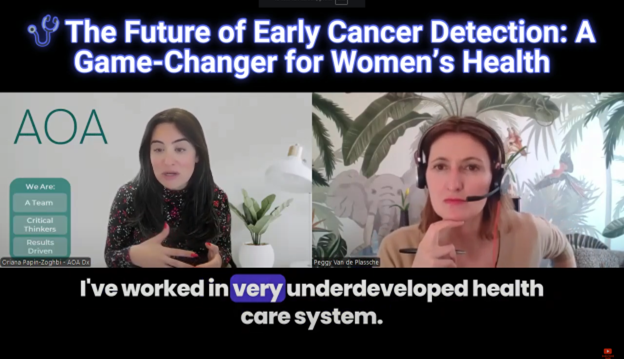
🩺 The Future of Early Cancer Detection: A Game-Changer for Women’s Health

Did you know that 30% of women who are ultimately diagnosed with ovarian cancer are first referred to a mental health specialist and prescribed antidepressants—dismissed as if their pain were all in their head—before ever receiving a proper diagnosis?

But imagine this: A simple blood test that could detect ovarian cancer early, saving countless lives. It sounds like science fiction, but thanks to cutting-edge innovation, it’s becoming a reality. In my latest conversation on my podcast, I had the privilege of speaking with Oriana Papin-Zoghbi, CEO of AOA Dx, whose mission is to revolutionize women’s health with early ovarian cancer detection using liquid biopsy technology.

This matters—80% of ovarian cancer cases are diagnosed at stage 3 or 4, when survival rates plummet to 28%. But if detected at stage 1 or 2, that number skyrockets to 90%. The problem? There has been no reliable, accessible diagnostic test—until now.

🛑 Why Has Ovarian Cancer Been So Hard to Detect?

Ovarian cancer is notoriously difficult to diagnose because:

  • Symptoms are vague and often dismissed as perimenopause, IBS, or stress.

  • It doesn’t show up clearly in imaging.

  • A tissue biopsy requires surgery—by the time it’s confirmed, it’s often too late.

This diagnostic gap has left women waiting 9 months on average for a proper diagnosis, often undergoing a frustrating trial-and-error approach with doctors.

🩸 A Blood Test That Could Save Lives

AOA Dx’s breakthrough lies in novel lipid biomarkers—a game-changer in cancer detection. Unlike traditional diagnostics that focus on proteins, circulating DNA, or tumor cells, this approach identifies glycolipids shed into the blood by ovarian cancer cells, offering an early and accurate detection method.

🚀 Why Now? The Tech Finally Caught Up

What’s exciting is that this wasn’t possible 10 years ago. Advances in:

  • Machine learning & AI for multiomic data analysis

  • Precision instruments capable of detecting lipid biomarkers

  • Improved diagnostic algorithms for more accurate results

…have finally aligned to make early detection of ovarian cancer a reality.

Share

📉 Healthcare’s ‘Treat, Not Prevent’ Problem

A recurring theme in our discussion was the reactive nature of healthcare. The system is built to treat diseases, not prevent them, which means funding and focus have lagged for early diagnostics. Ovarian cancer has had no major innovations in 30 years, partly because:

  • It lacks a high-profile awareness movement (think breast cancer’s pink ribbon).

  • It wasn’t prioritized for research and funding.

  • The biology of ovarian cancer makes early detection particularly challenging.

💰 The #1 Barrier? Reimbursement & Public Policy

Even with groundbreaking technology, getting healthcare systems to pay for it is a battle. In the U.S., insurance reimbursement for diagnostics can take years to approve—far too long for startups trying to survive. Without financial support, innovation dies before it reaches patients.

Public policy needs to evolve to streamline reimbursement, making early detection tests more accessible and preventing late-stage diagnoses that cost the system far more in the long run.

💡 The Takeaways: What Needs to Happen?

1️⃣ Patients need to self-advocate – Women must push for answers when experiencing symptoms, not accept dismissals or delays.

2️⃣ Physicians need better tools – Doctors currently have no reliable test to differentiate ovarian cancer from other conditions. AOA Dx’s blood test changes that.

3️⃣ Healthcare needs a prevention mindset – Investing in early detection saves lives and money. Policymakers and insurers need to step up.

⏳ The Future of Women’s Health is Here

This is bigger than just one test—it’s about redefining how we approach women’s healthcare. By focusing on early diagnosis, leveraging AI-driven precision medicine, and advocating for smarter healthcare policies, we can move from a reactionary system to a preventative, life-saving one.

Are we ready to make early detection the norm? Let’s keep the conversation going—hit Reply and share your thoughts!

Stay empowered,

Peggy Van de Plassche

Peggy Van de Plassche is a seasoned advisor with over 20 years of experience in financial services, healthcare, and technology. She specializes in guiding boards and C-suite executives through transformational change, leveraging technology and capital allocation to drive growth and innovation. A founding board member of Invest in Canada, Peggy also brings unique expertise in navigating complex issues and fostering public-private partnerships—key elements in shaping the Future of Business. Her skill set includes strategic leadership, capital allocation, transaction advisory, technology integration, and governance. Notable clients include BMO, CI Financial, HOOPP, OMERS, GreenShield Canada, Nicola Wealth, and Power Financial. For more information, visit peggyvandeplassche.com.

#biotech #cancer #healthcare #womenshealth

4191057